
Wolf Appliance Repair
Wolf range, wall oven, steam oven, cooktop and rangetop repair in Denver and 30 nearby cities. Same-day service, 90-day parts and labor warranty.
Wolf appliance repair in Denver: dual fuel, gas and induction ranges, wall ovens, steam ovens, cooktops and rangetops. The Appliance Team repairs Wolf cooking products across the Denver metro and 30 surrounding cities, from legacy R Series gas ranges to current M Series and E Series wall ovens and convection steam ovens. We read the fault log, test RTD sensors, elements and fans against the values in Wolf’s service manuals, and use genuine OEM parts whenever they’re available. The $99 service call is waived when you go ahead with the repair, you get a written quote before any work starts, and every repair carries a 90-day warranty on parts and labor.
4.9★ on Google · $99 service call waived with the repair · Written quote before any work · 90-day warranty on parts and labor · EPA 608 certified technicians · Same-day or next-day visits
On this page: Common repairs · Real repair cases · Error codes · Quick checks · High altitude · Maintenance · Repair or replace · Cities we serve
Wolf ranges, rangetops and wall ovens are a regular part of our work. Our technicians, with more than 30 years of combined experience and over 10,000 appliance repairs behind the company, service Wolf cooking appliances across the Denver metro, often in the same kitchens as the Sub-Zero refrigerators we repair. The Wolf repairs we do most often are burner and oven igniters, griddle thermostats and gas valve switches, door latches, and oven light and fan switches.

Wolf products and series we repair
In Wolf wall oven model numbers, SO means single oven and DO double oven, and the T and P after the size mean Transitional and Professional styling. So an SO3050PE is a 30-inch single E Series oven in the Professional style.
| Product line | Series / model prefixes | What we fix |
|---|---|---|
| Dual Fuel ranges | DF30, DF36, DF48, DF60 (legacy); later DFxx50 models | Oven heating, door lock (01), RTD (03 / 04), burner ignition |
| Gas ranges | GR; legacy R Series (R304, R364C, R486G, R606DG) | Burner ignition, glow-coil igniter, safety valve, altitude kits |
| Induction ranges | IR | Oven codes, cooktop overheat, fans, generator |
| E Series wall ovens | SO3050TE/PE, DO3050TE/PE (2021–); SO30/DO30 TE/PE/CE (2015–2020); SO24TE (2016–); SO30-2/DO30-2 (2007–2014) | 3222 RTD and 3311 TCO faults, elements, relay board, door lock, touch controls |
| M Series wall ovens | SO30/DO30 TM/PM/CM (2015–2023); SO3050/DO3050 TM/PM/CM (2023–) | 4-digit fault codes, relay board, UIP control, convection and cooling fans |
| L Series wall ovens | Legacy L Series | Elements, sensors, door lock, controls |
| Convection steam ovens | CSO24 / CSO30 (e.g. CSO2450TE/S/T, CSO3050) | Descaling faults, boiler, sensors, drain pump |
| Speed ovens | SPO | Heating and control faults |
| Cooktops | CG gas; CI and CT induction; grill, steamer, fryer and teppanyaki modules | Ignition, induction generator and coil, control faults |
| Rangetops | SRT sealed burner, RT | Burner ignition, spark module, valves |
| Microwaves and warming drawers | MD24 / MD30 microwave drawers; WWD30 and legacy WD30 warming drawers | Not heating, drawer and control problems |
Most common Wolf repairs
| Symptom | Usual cause | Part / fix |
|---|---|---|
| Surface burner clicks constantly or won’t light (GR, R, DF, SRT, CG) | Wet or dirty igniter, misaligned burner cap, clogged ports, stuck knob, wrong outlet polarity | Dry and seat the parts; otherwise spark module, electrode / igniter or burner-valve micro switch |
| Gas oven won’t bake (GR, R Series) | Weak glow-coil (hot-surface) igniter, bimetal safety valve, thermostat or a connection | Glow-coil igniter, safety valve |
| Electric oven not heating or slow to preheat (E, M, DF, L) | Bake, broil or convection element (40xx–43xx), relay board (0xxx–1xxx) | Element or relay board |
| Temperature off, or the oven won’t run (3121–3222, DF 03 / 04, SO24 E09) | RTD oven temperature sensor | RTD sensor (about 1,076 Ω at 68°F) |
| Self-clean won’t start or the door stays locked (DF 01, 3421 / 3422, 3521 / 3522) | Motorized door lock (MDL) assembly or switches | MDL assembly, door switches |
| Oven shuts off mid-cook (3311 / 3312, 4910, 5220 / 5320) | Thermal cutoff tripped by overheating: cooling fan, installation or cabinet airflow | Cooling fan, TCO, installation correction |
| Convection not working (4531–4632) | Convection fan motor not detected | Convection fan motor |
| Touchscreen or knobs unresponsive (6xxx, 8xxx, 9xxx; SO24 E49 / E12) | UIP / UIM control board, display, touch panel, knob encoder | Software reflash, or the control part |
| Steam oven descale messages, E44, E66–E73 | Scale in the boiler and water system | Descale; boiler heating element, inlet valve, drain pump or level sensor |
| Induction zones shutting off (E2, E8, 36) | Overheating, cooling fan, induction generator | Cooling fan, generator, coil, control board |
Surface burners that click or won’t light
This is the most common Wolf gas call. Wolf’s own answer for GR ranges lists a wet or dirty igniter, a burner cap that isn’t seated, clogged burner ports, a stuck knob and wrong outlet polarity. If the burner still clicks with dry, clean, seated parts, the problem is usually the burner-valve micro switch that tells the spark module a knob is on, or the spark module itself. We check polarity with a meter and replace the faulty part.
Gas oven bake burner: the glow-coil igniter
Wolf gas ovens (GR and R Series) light the bake burner with a glow-coil, or hot-surface, igniter that works with a bimetal safety valve. Normal lighting takes 30–45 seconds. If it takes much longer or never lights, the cause is usually a weak igniter, then the safety valve, thermostat or a connection. Gas valves are a technician job; don’t take the oven floor apart yourself.
Wall oven 3222 and 3311: sensors and overheating
On M Series and current E Series wall ovens, 3221 or 3222 means the upper or lower RTD temperature sensor reads open. We measure it: a good RTD reads about 1,076 ohms at 68°F, and if it does, the wiring or relay board is next. 3311 or 3312 means the thermal cutoff (TCO) opened because something overheated. Wolf points to the installation and cabinet fit, the cooling fan, the door gasket, a room above 86°F and wiring. We check the cooling fan and installation first, or the code comes back.
What we actually find on Wolf calls
The tables above list what usually fails. These are the repairs we have actually done on Wolf appliances, with photos from our own jobs.
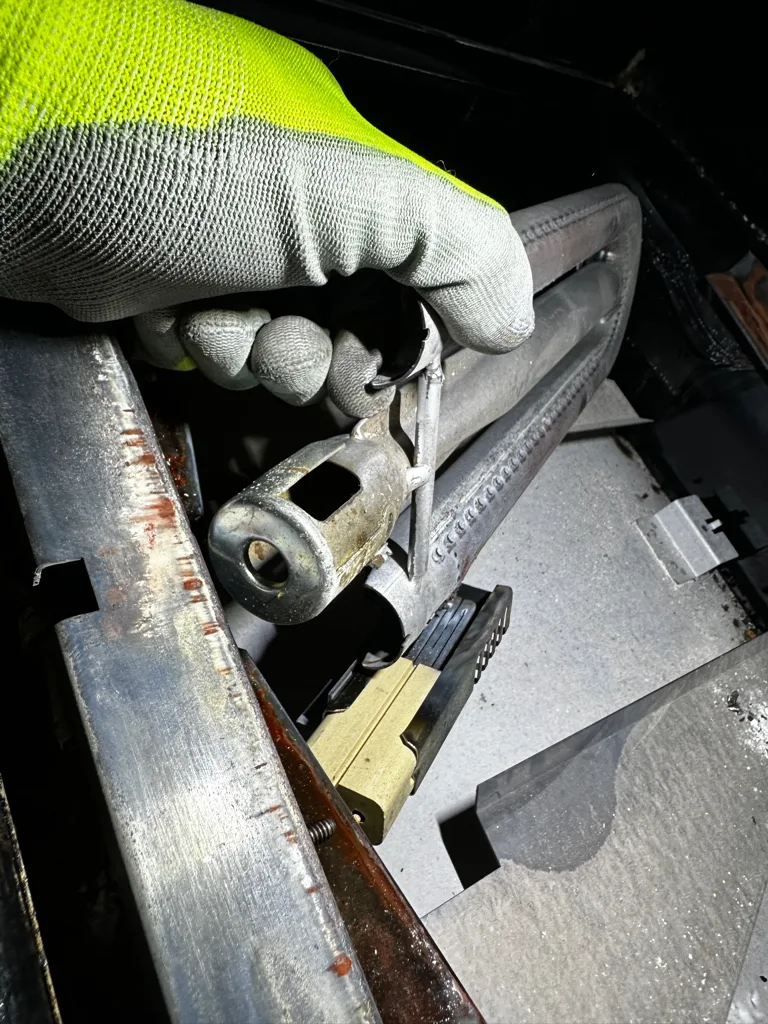
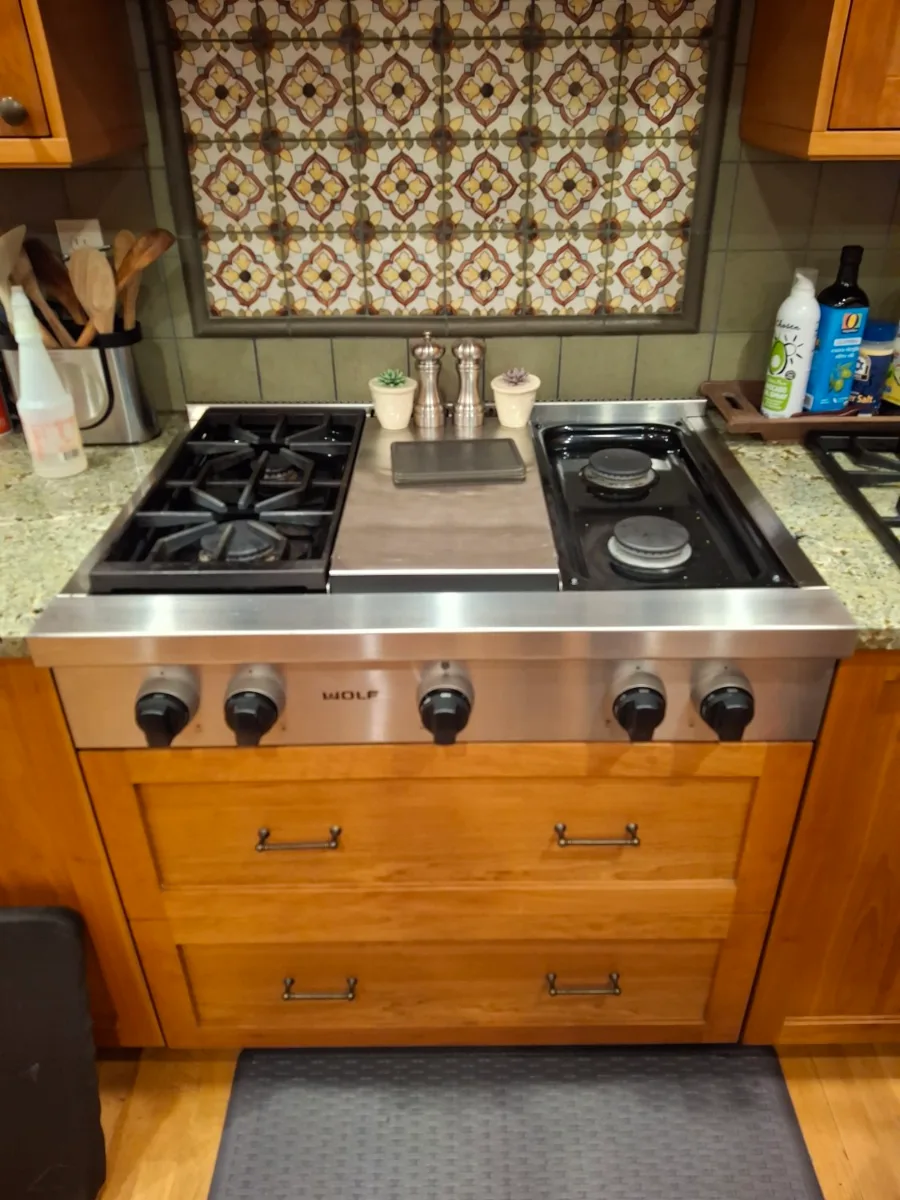
1. Igniters: oven and surface burners
Most of our Wolf calls come down to ignition. In June 2024 a Wolf oven would not light and needed a new igniter. In April 2026 we worked on a Wolf range’s spark ignition, and in September 2026 a Wolf stovetop’s burners would not light until we replaced the right front igniter. In October 2025 we were called to a Wolf stove with one burner that would not work.
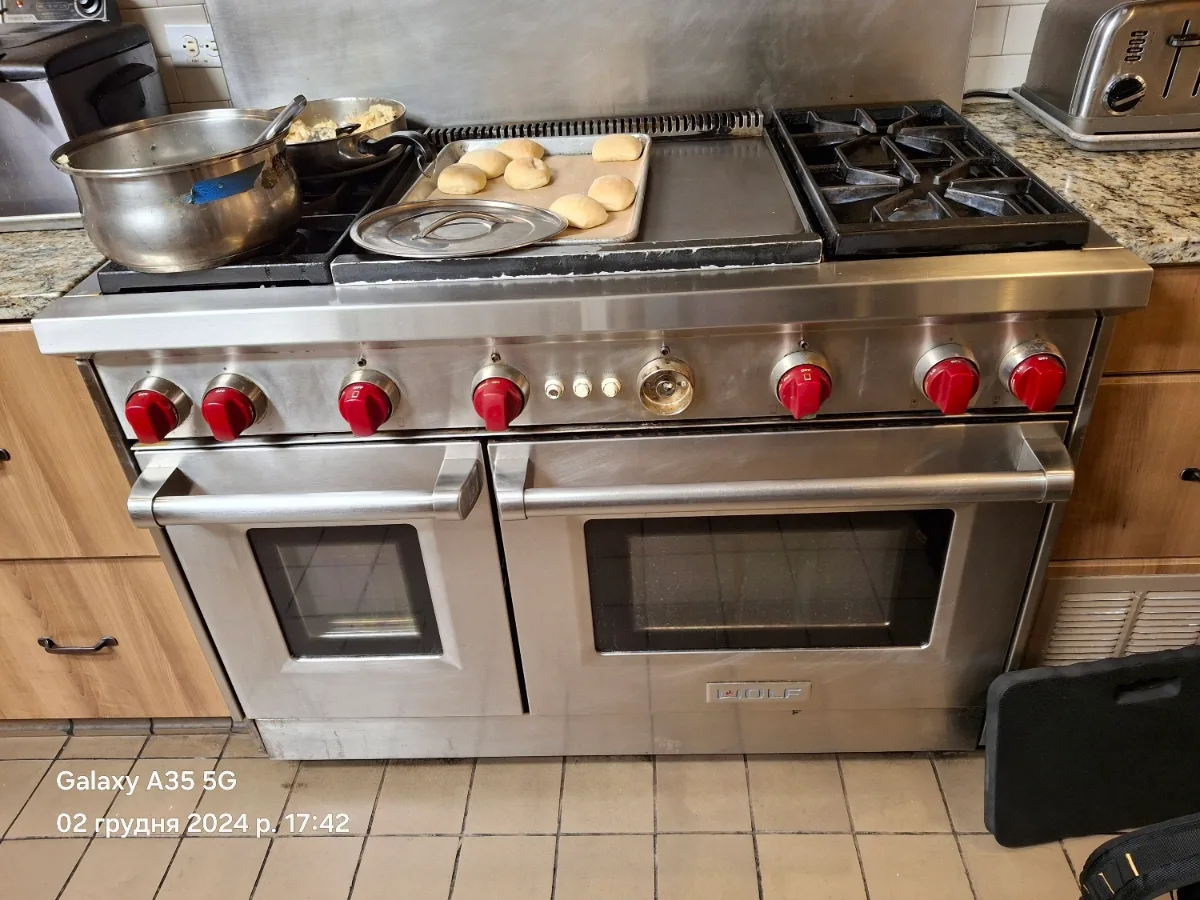
2. Griddles and gas valves on 48-inch ranges
In December 2024 a Wolf 48-inch dual-fuel range with a griddle stopped working properly; it needed a new griddle thermostat and a new valve switch.
3. Wall ovens: latches, switches and self-clean
In November 2024 a Wolf double oven stopped working because of the door latch, which we replaced. In October 2025 we replaced the light and fan switches on another Wolf double oven. In July 2026 a Wolf oven that would not finish self-clean checked out with no faults found. We also installed a Wolf double oven in July 2025.
Wolf burner not lighting or oven not heating? Call 720-230-1229. We answer 24/7 and can usually be there the same or next day.
From our Wolf service log
- June 2024, oven not lighting. A new oven igniter.
- November 2024, double oven not working. A new door latch.
- December 2024, 48-inch range. A new griddle thermostat and valve switch.
- October 2025, double oven. New light and fan switches.
- April 2026, range ignition. Spark igniter work.
- July 2026, self-clean not finishing. No faults found.
- September 2026, burners not igniting. A new right front igniter.
Wolf error codes and what they mean
Wolf code meanings depend on the product and the control generation. A 4-digit M Series code, a 2-digit legacy Dual Fuel code and an E-code on a steam oven are separate systems, so match the table to your product. Gas cooktops, gas ranges and rangetops have no numeric codes; their faults show as clicking or no ignition.
- 4-digit codes (M Series and current E Series wall ovens): digit 1 is the group (0–2 relay board, 3–4 external component or wiring, 5 temperature, 6 UIP board, 7 knob, 8 display, 9 touch). Digit 2 is the item. Digit 3 is priority (1 safety, always shown; 2 shown when cooking; 3 logged only). Digit 4 is the cavity (0 system, 1 upper or single, 2 lower).
- View the fault log: Settings, then About, then hold OK for 10 seconds and open the Faults tab. It shows up to 20 faults and has a Clear Faults button.
- Earlier E Series (SO30-2 / DO30-2): faults show as phrases such as “RTD Open/Shorted” or “MDL run timeout”, pointing to the same parts.
Write the code down, or photograph the fault log, before you call or clear it. It tells us which part to bring.
M Series and current E Series wall ovens (4-digit codes)
| Code | Meaning | What usually fixes it |
|---|---|---|
| 0021 / 0022, 0321 / 0322, 0821 / 0822 | Upper / lower bake, broil or door-lock (MDL) relay shorted | Relay board |
| 1021 / 1022, 1321 / 1322 | Upper / lower bake or broil relay open | Relay board |
| 2720 / 2C20 | Output drive (element / MDL) watchdog fault / relay board network (RS485) fault | Breaker off 30 seconds; relay board, cable or UIP |
| 3031 / 3032 | Upper / lower meat probe shorted | Probe should read about 62 kΩ at 68°F; probe or jack |
| 3121 / 3122 | Upper / lower RTD shorted | RTD (about 1,076 Ω at 68°F) or relay board |
| 3221 / 3222 | Upper / lower RTD open | RTD sensor, wiring, relay board |
| 3311 / 3312 | Upper (or single) / lower thermal cutoff (TCO) open | Overheating: installation, cooling fan, gasket, room above 86°F, wiring |
| 3421 / 3422 | Upper / lower door-lock (MDL) timeout | MDL motor or switches; needs a breaker reset |
| 3521 / 3522 | Door open or unlocked during self-clean | MDL, door switch or magnet |
| 3B20 / 3C20 | Input voltage low (below 177 VAC) / high (above 265 VAC) | House supply, terminal block |
| 4031 / 4032 | Bake element not detected | Element should read 15.4–17 Ω; bake element |
| 4231 / 4232, 4131 / 4132, 4331 / 4332 | Broil / convection element not detected | Broil 14.8–16.4 Ω, convection 22–25.6 Ω; replace the element |
| 4421 / 4422, 4910 / 4A10 | Cooling fan not detected (about 45 Ω) / cooling fan stalled | Cooling fan |
| 4531 / 4532, 4631 / 4632 | Convection fan not detected | About 90 Ω; convection fan |
| 5021 / 5022, 5121 / 5122 | Cavity over-temperature: above 950°F in clean / above 600°F not in clean | RTD check, flash or replace the UIP, relay board |
| 5220 / 5320 | Relay board / UIP ambient over-temperature (above 185°F) | Airflow, cooling fans, board |
| 5431 / 5432 | Low rate-of-rise in self-clean | Elements, voltage, wiring |
| 6110–6D10, 7021–7122 | UIP / UIM software, memory or communication fault / knob encoder fault (Professional) | Flash software; UIP, UIM, control panel or encoder |
| 8010 / 8110, 9010 / 9020 / 9120 | Display backlight or display fault / touch sensor or touchpad fault | Display or control panel |
SO24 E Series 24-inch wall oven (legacy)
| Code | Meaning | What usually fixes it |
|---|---|---|
| E09 | Short in the temperature sensor or its wiring | Breaker reset; sensor or wiring |
| E12 | Faulty relay board | Relay board |
| E49 | Button jammed or moisture on the control board | Keypad or control board |
| E56 | Software incompatible with the supplementary board / outdated firmware | Firmware update |
Legacy Dual Fuel range (DF30–DF60) and IR induction range oven
The IR induction range oven uses the same table. Its knob display can also show PF (power failure, J2 connector or RTD), HOT (mode selected while the oven is above its threshold), Err (a code is logged; view it in diagnostics) and SAb (Sabbath mode).
| Code | Meaning | What usually fixes it |
|---|---|---|
| 01 (ERR 01) | Door lock / unlock switches not sensed within 60 seconds, often in self-clean | Motorized door lock assembly or switches |
| 02 | Over-temperature (above 630°F unlocked / above 950°F locked) | RTD; if the RTD is good, the oven controller |
| 03 / 04 | RTD oven sensor open / shorted | RTD; otherwise the controller |
| 07 / 0C | Communication lost between the ECH and the control board / with the controller | Cable, ECH, controller |
| 08 | EEPROM checksum error at power-up | Oven controller |
| 09 | Meat probe sensed shorted | Reseat or replace the probe; controller |
| 0B | A/D error during calibration | Controller |
| 0E | Power relay shorted, element circuit or relay drive failure | Relay board |
Convection Steam Oven (CSO24 / CSO30)
The CSO also shows two plain-language prompts: “Boiler Scaled Up, Please Descale!” and “Appliance Blocked, Descaling Necessary”. If the second persists after descaling, call for service.
| Code | Meaning | What usually fixes it |
|---|---|---|
| E03 | Incorrect process data (device ID) | Breaker off 30 seconds; reload data. E03 with F5 needs service |
| E09 / E10 | Cooking-space sensor shorted / open | Sensor or wiring |
| E17 / E18 | Food probe shorted / open, or moisture in the socket | Probe or socket |
| E29 | Cavity not sealed (door, exhaust valve, probe socket, fan seal), or too much frozen food | Gasket and seals |
| E35 / E38 | Processor or control unit too hot | Niche too hot, cooling fan failure |
| E44 | Water doesn’t reach temperature in 185 seconds | Descale; boiler heating element, overtemp protector |
| E66–E73, E74–E76 | Water level and pump faults, mostly a scaled-up boiler / error during descaling or rinsing | Descale; inlet valve, drain pump; foam from the wrong descaler |
| E78 / F24 | Drain issue | Pour water down the drain and clean the drain filter |
Induction cooktops and range tops
| Code | Meaning | What usually fixes it |
|---|---|---|
| 03 (CI cooktop, IR range top) | Continuous sensor activation | Wipe water or cookware off the control area, then breaker reset |
| E2 (IR cooktop zone) | Coil temperature too high | Fan, vent, coil assembly |
| 36 (IR cooktop) | Control temperature too high | Fan, vent, oversized pans over the controls, heat lamps |
| E8 (IR cooktop) | Fan error | Fan, generator |
| E8 / E08 (CT cooktop) | Generator 1 communication error | Breaker reset; service (the generator may no longer be available) |
| E01 (IR range cooktop) | Left key error (secondary control) | Breaker reset; service |
Code still on the display? Call 720-230-1229. We answer 24/7 and can usually be there the same or next day.
Before you call: safe checks
- For a clicking burner, let the igniter dry completely after a spill, make sure the burner cap is seated correctly and clear the ports with a toothpick.
- For an oven code such as 2720 or a CSO E03, turn the breaker off for 30 seconds and back on. If the code returns, write it down and call.
- For a gas oven, give the bake burner the normal 30–45 seconds to light before deciding it has failed.
- For induction code 03, wipe water and cookware off the control area, then reset the breaker.
- For a steam oven, descale when prompted (Wolf specifies Durgol Swiss Steamer), use fresh cold tap water, and clean the drain filter for E78 or F24.
- If you smell gas, don’t troubleshoot: leave the house and call your gas utility.
Denver and high-altitude notes for Wolf
Denver sits at about 5,280 feet, and Wolf’s installation guides set clear altitude limits for gas ranges. The two guides give different numbers:
| Range | Natural gas, no adjustment | LP, no adjustment |
|---|---|---|
| Dual Fuel (DF) | Up to 10,250 ft | Up to 8,600 ft; above that, a high-altitude conversion kit from an authorized Wolf dealer |
| Gas range (GR) | Up to 8,600 ft; above that, a conversion kit | Wolf states LP gas ranges do not require conversion |
No altitude conversion is required for a Wolf DF or GR range at 5,280 feet under either guide. Mountain homes above 8,600 feet may need a kit, depending on the range and the fuel.
Legacy R Series high-altitude orifice kits
For legacy R Series gas ranges (serial 11,012,416 and up), Wolf made orifice-based high-altitude conversion packages in 1,000-foot bands. They replace the griddle, charbroiler, French top and oven burner orifices and must be installed by a qualified agency.
| Package | Elevation band |
|---|---|
| 803207 | 6,000–6,999 ft |
| 803208 | 7,000–7,999 ft |
| 803209 | 8,000–8,999 ft |
| 803210 | 9,000–9,999 ft |
| 803211 | 10,000–11,000 ft |
This matters mostly for foothill and mountain homes, where the package must match the elevation band.
High-altitude baking with a Wolf oven
Wolf says cooking can start to be affected at 2,000–3,000 feet, and water’s boiling point drops about 1°F for every 500 feet, to roughly 202°F in Denver. Wolf does not give oven-setting changes for altitude; it points bakers to high-altitude baking resources, and the same recipe adjustments apply to steam ovens. For the convection steam oven itself, Wolf calls altitude a non-issue because the humidity sensor controls moisture; water simply boils at a slightly lower temperature. If cakes fall or bread over-rises in a new high-altitude kitchen, it is usually the recipe, not the oven. If you suspect the oven, we can check its temperature sensor and calibration.
Find your Wolf model and serial number
| Product | Where the tag is |
|---|---|
| Dual Fuel, gas and induction ranges | Bottom of the control panel, far right (open the oven door) |
| R Series gas range | Under the left burner pan, left wall of the burner box |
| E Series SO3050 / DO3050, M Series ovens | Near the bottom trim, left side; on double ovens, the lower oven |
| E Series SO30 / DO30, L Series ovens | Below the control panel, right side (door open) |
| SO24TE, convection steam oven, speed oven | Left side of the front face frame (door open) |
| Induction cooktops | Bottom of the cooktop |
| SRT rangetop | Bottom of the control panel, far right |
| RT rangetop | Under the left burner pan, left wall |
| Microwave drawer | Bottom of the cavity behind the drawer (drawer open) |
| Warming drawer | Left front floor of the inner cabinet; WD30: back of the drawer front plate |
| Hoods | Under the left side, above the filters (Pro hoods: inside wall) |
Wolf maintenance schedule
| Task | How often | Why |
|---|---|---|
| Descale the convection steam oven | Every 6–18 months, depending on water hardness | Prevents E44 and E66–E73 faults. Set hardness with the supplied test strip; Durgol Swiss Steamer only |
| Fill the CSO with fresh cold tap water | Every use | Not distilled or filtered: the unit needs minerals. With whole-house filtration, use bottled water |
| Wipe the CSO dry and run Clean mode | After each use; Clean mode (176°F, 30 min) as needed | Don’t clean the gasket or use steam cleaners |
| Clean Pro hood filters and grease cups | About monthly; more often with frying or wok cooking | Degreaser or the dishwasher; keeps grease out of the hood |
| Keep gas burner ports clear and caps seated | After spills and during cleaning | Prevents clicking and poor ignition; dry the igniter after spills |
Factory warranty vs. our repair warranty
Wolf’s residential limited warranty runs from the original installation date:
| Coverage | What it includes |
|---|---|
| 2-year full | Parts and labor, through Wolf Factory Certified Service |
| 5-year limited (parts only) | Gas burners (appearance excluded), electric heating elements, hood blower motors, electronic control boards, magnetron tubes and induction generators; the owner pays labor |
| 60-day cosmetic | Stainless and powder-coated surfaces |
| Factory Certified Installation | When an FCI company installs the product, the full warranty extends to 3 years; the 5-year limited parts coverage stays |
The warranty excludes hood recirculating filters and damage from improper installation or use.
We repair Wolf appliances in or out of warranty, and the choice of who does the work is yours. Some owners call us during the warranty period because they want a faster appointment or a technician who works on Wolf every day. If you prefer to file a claim with Wolf, keep your proof of purchase handy; if you want us to fix it, you get a written quote before any work starts. Every repair we do carries our 90-day warranty on parts and labor.
Every repair we do carries our own 90-day warranty on parts and labor.
Still having trouble with your Wolf? Call 720-230-1229. We answer 24/7 and can usually be there the same or next day.
Repair or replace your Wolf?
Wolf does not publish an official lifespan figure, so we won’t quote one. Most Wolf failures are replaceable parts: igniters, spark modules, RTD sensors, elements, fans, door locks, relay boards and controls. A new Wolf range or wall oven costs many thousands of dollars and often has to fit existing cabinetry, so a repair is usually the better choice.
Replacement starts to make sense when a key part is no longer available (Wolf notes the generator for some CT induction cooktops may not be), or when several major parts fail at once on an older unit. We will tell you plainly when a repair isn’t worth it.
Wolf repair near you
We repair Wolf appliances in Denver and every city we serve across the metro, with same-day or next-day visits. Tap your city to see local service details:
See also our oven repair and range repair pages, and our Sub-Zero, Thermador and Viking brand pages.
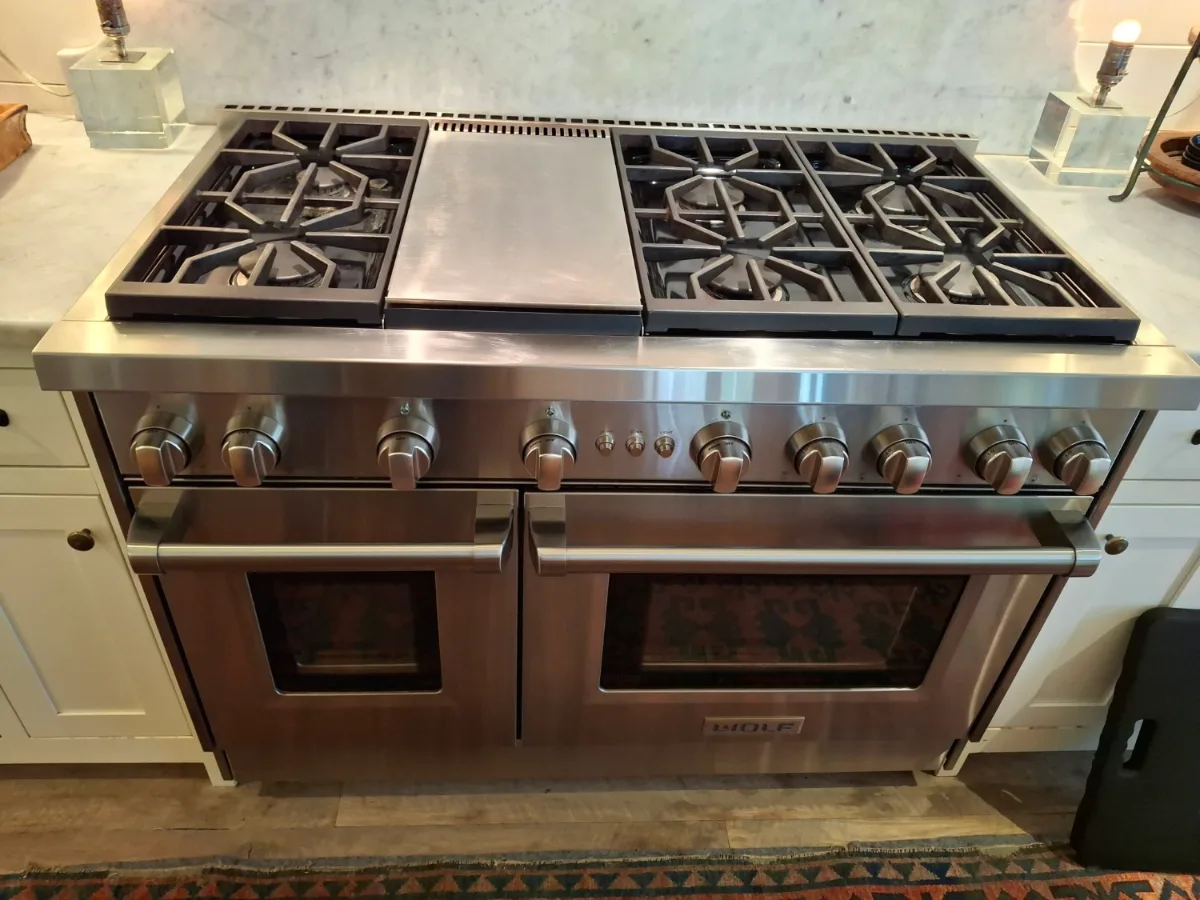
Common Wolf Appliance Repair Issues We Fix
Why Choose The Appliance Team?
Denver's trusted appliance repair company — professional service you can count on.
Same-Day Service
Same-day appliance repair in Denver — call early and we can often be there today. No waiting around for weeks.
90-Day Warranty
90-day warranty on parts and labor for every repair we perform.
Certified Technicians
Our Denver appliance repair technicians are trained on all major brands and use genuine manufacturer parts.
Transparent Pricing
Service fee waived with repair. No hidden charges, no surprises.


Frequently Asked Questions
The home service call is $99, and it's waived when you go ahead with the repair. After diagnosis you get a written quote before any work starts. Every repair carries a 90-day warranty on parts and labor.
On M Series and current E Series ovens, 3222 means the lower oven's RTD temperature sensor reads open (3221 is the upper or single oven). The fix is usually the RTD sensor, which should read about 1,076 ohms at 68°F; if it tests good, the wiring or relay board is next.
Most often the igniter is wet or dirty, or the burner cap isn't seated. Let it dry, seat the cap and clear the ports with a toothpick. If it still clicks, the burner-valve micro switch or spark module usually needs replacing.
No. Wolf's Dual Fuel guide allows natural gas up to 10,250 feet and LP up to 8,600 feet without adjustment, and the GR gas range guide allows natural gas up to 8,600 feet. Denver is about 5,280 feet, so only mountain homes above 8,600 feet may need a kit.
Wolf gives a 2-year full warranty on parts and labor (3 years with Factory Certified Installation) and a 5-year limited, parts-only warranty on gas burners, heating elements, control boards, induction generators and some other parts. We repair Wolf appliances in or out of warranty, and every repair we do carries our own 90-day parts and labor warranty.
Wolf range or oven not working?
Call 720-230-1229 or book online. Same-day Wolf repair on most weekdays across the Denver metro, a written quote before any work, and a 90-day warranty on parts and labor.


