
If your oven used to preheat in a few minutes and now takes half an hour, or never quite gets there, something has changed inside. On gas ovens the usual cause is a weak igniter. On electric ovens it is usually a bake element that has failed, leaving the broil element to do all the work. Igniters (45 calls) and bake or broil elements (26) are among the most common repairs in our 645 oven and range calls since 2024.
At a glance
- Gas oven slow to light or preheat: a weak igniter is the most likely part.
- Electric oven slow to preheat, with the top element glowing but not the bottom: the bake element has probably failed.
- An oven that reaches temperature slowly and cooks unevenly can also have a bad temperature sensor or a worn door gasket.
- Compare against your manual: many ovens are designed to take several minutes or more to reach baking temperature.
Gas ovens: the igniter
A gas oven igniter has to get hot enough to draw a set current before the gas valve opens. As it ages, it heats more slowly and draws less current, so the oven takes longer and longer to light, and eventually doesn’t light at all. You may see the igniter glow for a minute or more before the burner catches, or smell a little gas before ignition. On a Viking oven in Denver, we replaced two burners and two igniters.
If you smell gas strongly or for long, turn the oven off and don’t use it until it is checked.

Electric ovens: the bake element
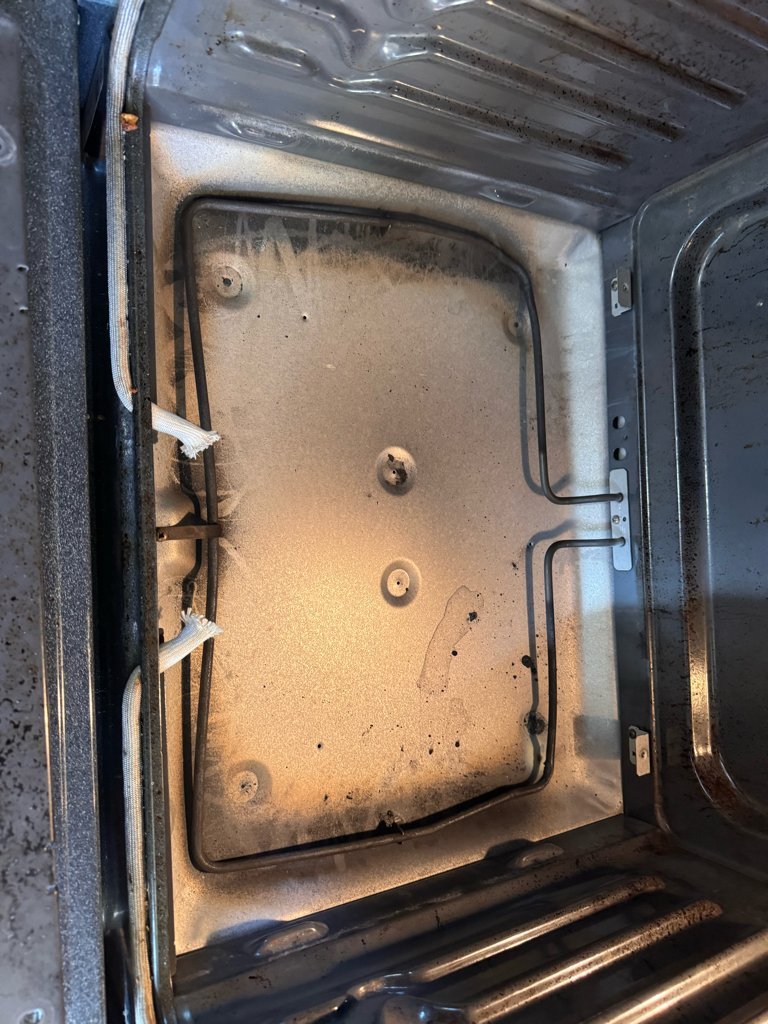
Most electric ovens use both the bake (bottom) and broil (top) elements during preheat. If the bake element fails, the broil element alone heats the oven, slowly and unevenly. A visible bake element often shows a break, a blister or a burned spot. Many newer ovens hide the bake element under the oven floor, so you can’t see it: on a Maytag in Westminster that was heating up slowly, the hidden bake element was the part we replaced.
Check: during preheat, look at the elements you can see. If only the top one glows, the bottom one is likely the problem.

Temperature sensor and control
The oven sensor reports the temperature to the control board. A sensor that drifts can make the board think the oven is hotter or colder than it is, so preheat takes longer or ends early. Temperature sensors and control boards both appear in our oven records. Testing the sensor’s resistance tells a technician which one it is. For ovens that heat but run hot or cold, see oven temperature wrong.
Other things that slow preheat
- A worn door gasket lets heat escape. Look for gaps or flattened spots.
- A convection fan that doesn’t spin makes convection modes heat slowly and unevenly.
- Oven racks, pizza stones and large pans left in the oven absorb heat and add minutes.
- Half power on electric ranges. If one half of the 240-volt breaker has tripped, some elements may not heat.
What you can check yourself
- Time a preheat to 350°F with an oven thermometer and compare it with your manual.
- Watch the elements on an electric oven, or the igniter glow on a gas oven, through the window.
- Remove stones and extra racks and try again.
- Reset the breaker on an electric range.
- Leave igniters, gas valves and wiring to a technician.
If the oven doesn’t heat at all, see our guide to an oven not heating.
Frequently asked questions
Why does my gas oven take so long to preheat?
Most often a weak igniter. It still glows, but it takes longer and longer to open the gas valve, so the burner lights late.
Why is my electric oven preheating slowly?
Usually a failed bake element, which leaves the broil element to heat the oven alone. A bad temperature sensor is the next suspect.
Does Denver’s altitude make ovens preheat slower?
Altitude changes how food bakes more than how fast the oven heats. See altitude and your appliances for what does change.
Oven taking forever? Call 720-230-1229.
Keep Exploring
Get it fixed
Oven repair by city
Troubleshooting guides
Maintenance guides
Error codes by brand
How to prevent this
Many of these breakdowns start with maintenance that was skipped. These guides show what to check, how often, and what happens if you don't: