
When an LG washer won’t drain or shows an OE code, the cause is usually one of four things: a clogged drain pump filter, a kinked or frozen drain hose, too many suds, or a failed drain pump. LG’s own guidance starts with the filter, and so do we. Washers are the second most common appliance we’re called for, with almost 1,900 washer jobs in our records since late 2023. This guide walks through the same steps our technicians use, in order.
At a glance
- OE means the washer can’t drain.
- First check: the drain pump filter behind the small panel at the bottom-left front (front-loaders).
- LG recommends cleaning that filter at least once a month.
- The Drain & Spin test tells you whether the pump motor is running.
- Drain pump replacement is a minor repair: from $179 in labor.
What the OE code means
According to LG, OE means the washer can’t drain the water from the tub. LG lists the usual causes as a kinked or clogged drain hose, a clogged drain pump filter, too many suds creating air pockets, and in cold weather a frozen drain hose. If water is standing in the drum after a cycle, treat it as an OE problem even without a code.
A few related codes are easy to confuse with it:
| Code | Meaning (per LG) |
|---|---|
| OE | Washer can’t drain |
| IE | No water coming in, or water pressure too low |
| dE / dE1 / dE2 (front-load) | Door can’t lock / door not closed / door closed but not locked |
| dE (top-load) | Lid not closed |
The full list is in our LG washer error codes guide.
Step 1: Clean the drain pump filter (front-load)
On LG front-loaders the filter sits behind the service panel at the bottom-left front. Have towels and a shallow pan ready; there will be water. LG’s steps:
- Turn off and unplug the washer.
- Open the panel and pull out the small drain hose. Remove its cap and drain the water into the pan.
- Turn the filter counter-clockwise to remove it.
- Clean the filter and its opening with a soft brush and warm water. Coins, hair ties, socks and lint are the usual culprits.
- Recap the small hose and turn the filter clockwise until it stops.
- Run Tub Clean. If OE comes back, use less detergent.
LG recommends cleaning this filter at least once a month, more often with heavy use. In hard-water cities like Thornton and Aurora, residue builds up faster; see hard water in the Denver metro.
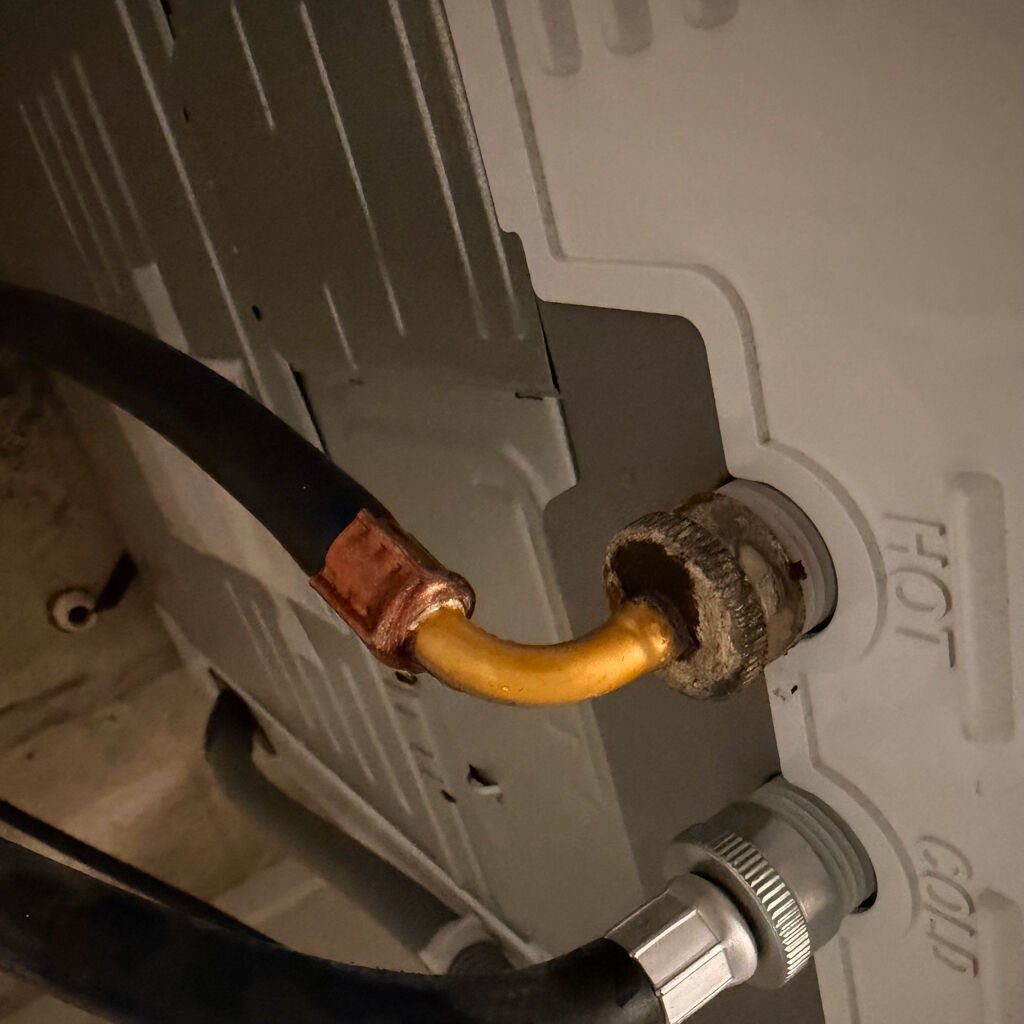
Step 2: Check the drain hose
- Pull the washer out and look for kinks, especially if it was recently moved.
- Make sure the hose isn’t pushed too far into the standpipe and isn’t sealed tight in it; the connection needs an air gap.
- On top-load models, LG says the end of the drain hose must be no higher than 96 inches above the bottom of the washer, with the elbow bracket attached within 4 inches of the hose end.
- In winter, check for a frozen hose if the washer is in an unheated garage or against an exterior wall. LG lists a frozen hose as an OE cause, and Denver’s average January low is below 20°F.
Step 3: Rule out too many suds
Too much detergent, or regular detergent instead of HE, creates foam that traps air in the pump. LG lists over-sudsing as an OE cause. Run a rinse-and-spin with no detergent, then use the dose on the HE detergent label, less for soft water.
Step 4: Run the Drain & Spin test
This tells you whether the pump motor is getting power and turning. LG’s steps:
- Press Power.
- Set Spin Speed to High.
- Press Start/Pause.
- Listen for a humming sound in the first 15 seconds.
If you hear the pump humming but water doesn’t move, the blockage is in the filter, the hose or the pump housing. If there is no hum at all, LG says the washer needs repair: the pump, its wiring or the control is the likely problem.
When to call a technician
- No hum during the Drain & Spin test.
- The filter and hose are clear, but OE keeps coming back.
- The pump hums loudly or grinds, which can mean a broken impeller or a foreign object in the pump.
- Water is leaking from under the washer.
We repair LG washers across the Denver metro, usually the same day. A drain pump replacement starts at $179 in labor plus the part; control boards start at $259. See LG washer repair and our washer not draining guide for other brands.
What our LG service calls show
In our own service records, the drain pump is the part we replace most on LG front-loaders that will not drain: 14 of 30 LG not-draining calls, almost always part 4681EA2001T, and the display usually shows OE. A cleaned filter or hose fixes some of them; a pump that hums but does not move water gets replaced.
If your LG is leaking rather than not draining, the cause is usually somewhere else: in our records the water inlet valve at the back is the most common source, not the door boot. See LG washer leaking, our general guide to washers not draining and LG washer error codes.
Frequently asked questions
What does OE mean on an LG washer?
According to LG, OE means the washer can’t drain. The usual causes are a clogged drain pump filter, a kinked or frozen drain hose, or too many suds.
Where is the filter on an LG front-load washer?
Behind the small service panel at the bottom-left front of the washer. LG recommends draining the small hose into a pan before turning the filter counter-clockwise to remove it.
How often should I clean my LG washer filter?
LG recommends cleaning the drain pump filter at least once a month, and more often with heavy use.
How do I test my LG washer drain pump?
Use LG’s Drain & Spin test: press Power, set Spin Speed to High and press Start/Pause. If you hear humming in the first 15 seconds, the pump motor runs; if not, it needs repair.
How much does it cost to replace an LG washer drain pump?
With us, drain pump replacement is a minor repair: from $179 in labor plus the part. The service call (from $59) is waived when you approve the repair.
Keep Exploring
Get it fixed
Washer repair by city
Troubleshooting guides
Maintenance guides
Error codes by brand
More from our blog
How to prevent this
Many of these breakdowns start with maintenance that was skipped. These guides show what to check, how often, and what happens if you don't: